I have a herniated disc. Do I really need surgery?
For most people, no, surgery is not the only road. A herniated disc means the soft center of a disc has pushed through its outer ring and is leaning on a nearby nerve. At Foudy Chiropractic in Mission Viejo, disc cases are the number-one reason a patient ends up on the decompression table. One show-and-tell visit with your own X-rays tells us honestly whether non-surgical care fits your case.
One unhurried visit tells you what is going on and whether Dr. Foudy can help. Thursday is afternoons only, 3:00 to 6:00 pm.
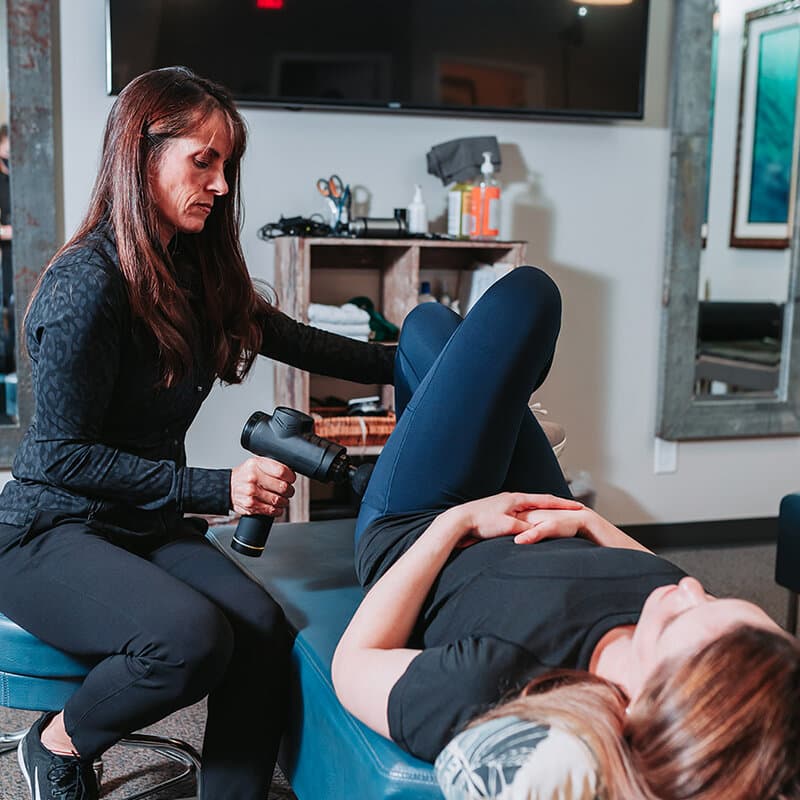
Staff setting up a patient on the AccuSpina spinal decompression table
In your own words
Does one of these sound like you?
Most patients arrive describing how they feel, not naming a diagnosis. If one of these is yours, you are in the right place. One visit tells you where you stand.
My doctor said I have a herniated disc and asked if I want surgery, and I'm not ready for thatI've got sharp pain shooting down one leg (or arm)There is numbness or tingling in a specific spot, like my foot or my fingersIt's way worse when I sit, cough, or sneezeOne muscle feels weak, like my grip or my foot
What is actually going on
What is actually going on, in plain terms.
A disc has a tough outer ring and a soft jelly center. Think of it like a jelly donut. A bulge is when the outer ring pushes outward. A herniation is when the ring tears and some of the jelly squeezes through. A prolapse is a bigger version of the same thing. They all sit on one spectrum. The pain you feel is not really the disc, it is the jelly leaning on a nerve, and that nerve carries the signal down your leg or your arm. Take the pressure off the nerve and the signal runs clean again. A disc problem rarely sorts itself out, which is why the right plan matters more than waiting it out.
Staff setting up a patient on the AccuSpina spinal decompression table
Can you help me, what is it, how long, and how much.
These are the four questions I hear on every first call, so here they are answered in order. The honest version of each, with real numbers, not a sales pitch.
Can you help me?
Yes, here is the honest answer.
Usually, yes, and this is squarely in my wheelhouse. Most herniated discs respond to non-surgical care without anyone ever opening your back. I screen honestly for the cases that do not, severe nerve loss, certain contraindications to decompression, and the rare emergencies. If you are not a candidate, I will tell you straight on the first visit.
What is it?
What is actually going on.
It is a disc pressing on a nerve. The X-rays show the structure, the neurological screen and the surface EMG show how the nerve is firing, and your own MRI, if you already have one, fills in the rest. I show you all of it. You will see your own films, not a stock diagram.
How long?
How long it usually takes.
When the disc is the driver, the standard decompression program is 20 visits, run as a correction phase, three times a week to start, then a progress exam partway through, then a taper to a retainer schedule, the way braces hand off to a retainer. Around visit 15, Melanie begins corrective exercise so the progress holds. Your exact plan is set after your exam.
How much?
What it costs, plainly.
The show-and-tell consultation that decides whether you are a candidate is $90 and about 75 minutes. The standard 20-visit decompression program is $3,000, with the chiropractic adjustment bundled in at half price for the duration. A single decompression session is $160, though a disc case responds to a course of care, not a one-off. Most insurance does not cover non-surgical decompression, so most patients pay cash, and Carmen can verify your coverage when you call.
Who this helps, and who it does not
Are you a candidate for care here?
You are likely a candidate if your herniation is leaning on a nerve and you do not have one of the genuine reasons decompression is off the table. When I refer out instead: severe osteoporosis, a spinal fracture, a tumor or cancer in the spine, a spinal infection, prior fusion or hardware at the level we would treat, pregnancy, or progressive neurological loss with saddle numbness or bladder and bowel changes. Those are not weakness on the table, they are honest exclusions, and the first visit is exactly what screens for them.
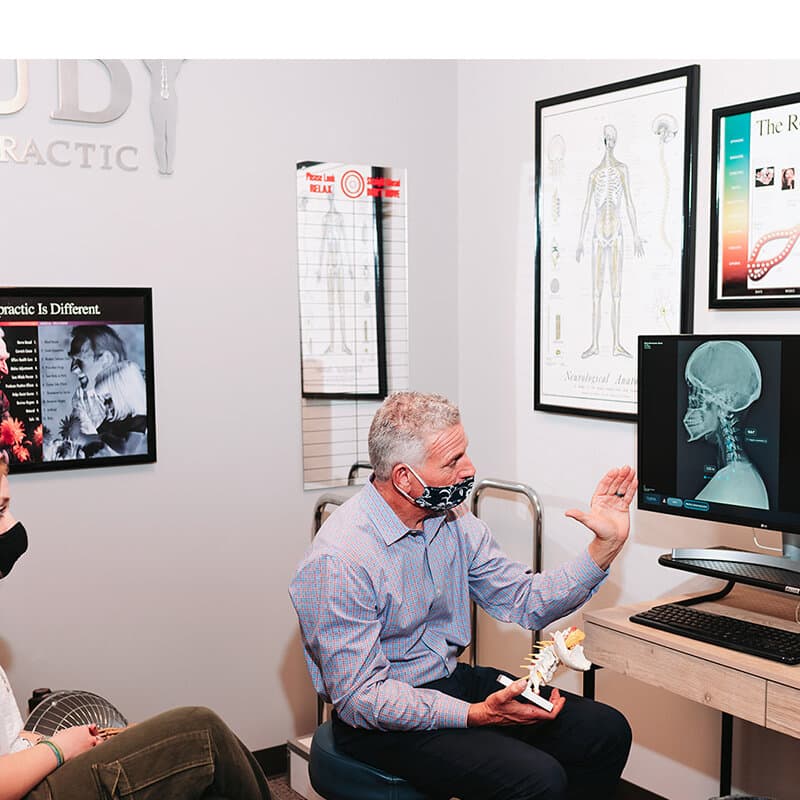
Dr. Foudy reviewing a patient's own X-rays before recommending a plan.
When the disc is the problem
Where spinal decompression fits.
Disc cases are the number-one reason this table exists. Spinal decompression with added oscillation on the AccuSpina gently separates the two vertebrae just enough to take pressure off the disc, and at the peak of each pull it oscillates, like a gentle pump. Laboratory and imaging studies suggest that easing the bones apart lowers the pressure inside the disc, which can help it draw in fluid, oxygen, and nutrients and calm the inflammation around the nerve. I frame that as how the table is designed to work, not a promise for any one patient. The honest measure is your own exam.
The AccuSpina is an FDA-cleared Class II device for non-surgical spinal decompression, and its oscillation is genuinely patented technology (USPTO US 7,717,870). Those are facts about the machine, not a promise about your case. Whether it fits you is exactly what the first visit screens for.
A patient set up for a decompression cycle on the AccuSpina table.
Straight talk
One visit tells you what is going on, and I will tell you straight.
The show-and-tell consultation is the full picture in one visit: the postural scales, the surface EMG (an EKG of your nervous system), the digital X-rays, and the hands-on exam, all in about 75 minutes. You will see your own scan and your own films, and you will leave with a straight answer about your herniated disc.
If this is mine to fix, I will tell you the plan. If it is not, I will tell you that too, and point you to what actually helps. I would rather send you down the street than put you on a plan that was never going to help your case. The first visit is $90 and runs about 75 minutes.
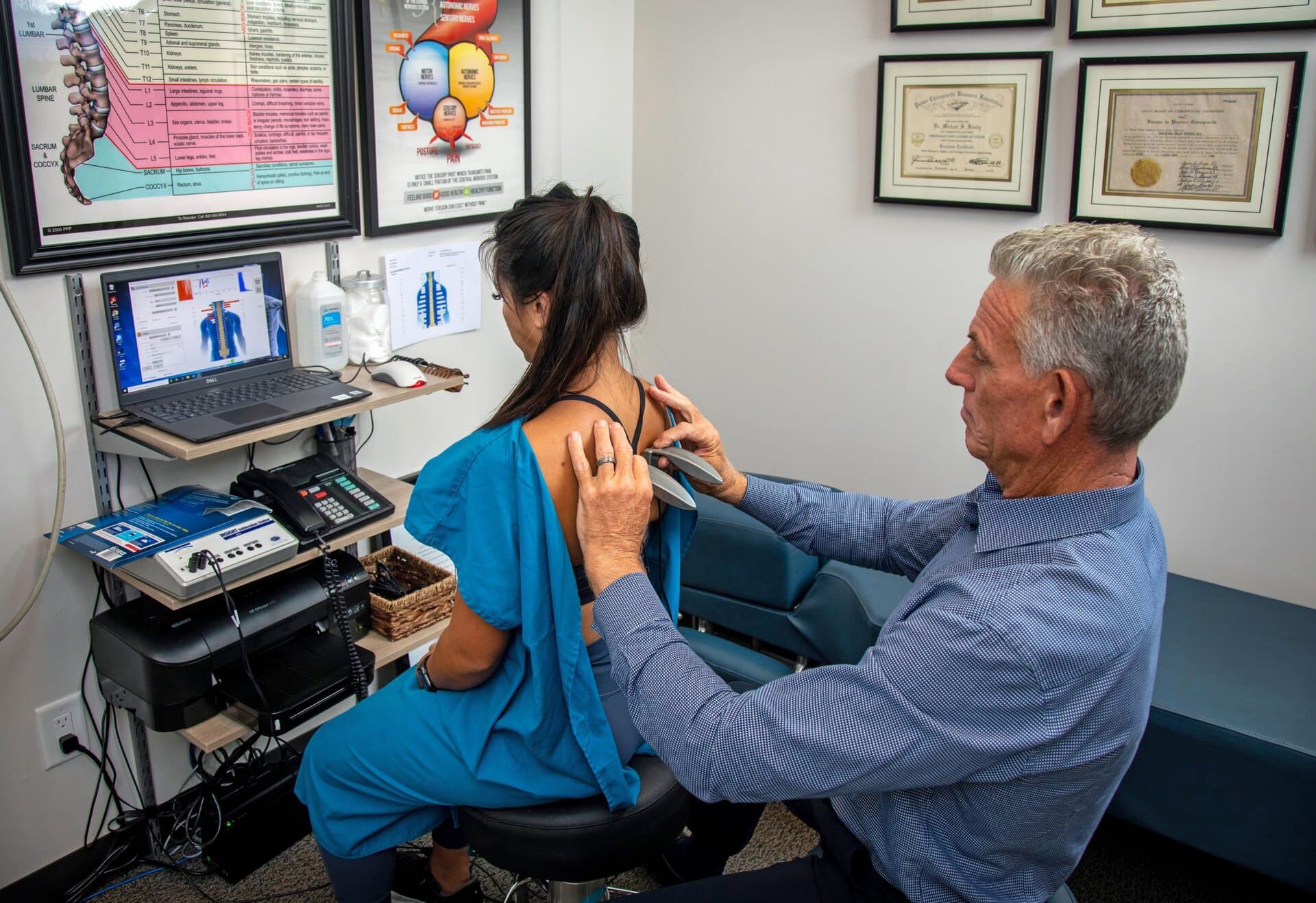
Dr. Foudy reviewing a computerized nervous-system scan with a patient, like an EKG of the nervous system.
Good questions, asked often
Questions patients ask about herniated disc
A herniation does not always fully retract, and I will not pretend it does. What decompression reliably does is take pressure off the nerve, help rehydrate the disc, and let the inflammation calm down. Most patients in the program leave off the pain and living their lives without surgery. That is the honest result, not a cure claim.
Patients with severe osteoporosis, a spinal fracture, certain tumors, a spinal infection, prior fusions or hardware at the treated level, pregnancy, or progressive neurological loss. I screen for all of it at the consultation, and if any of it is present, I point you to the right specialist.
Most insurance does not cover it, so most of our decompression patients pay cash. We are transparent about the cost upfront, $3,000 for the 20-visit program, and Carmen can verify what your plan does and does not cover when you call.
The patented oscillation at maximum load is the difference. In Dr. Foudy’s words, he flew to Florida, put the two top tables side by side, and chose the AccuSpina for the research behind it and that oscillation. His old budget table earned a nickname he still uses, the pickup truck Toyota. He does not buy pickup trucks anymore.
They are on the same spectrum. A bulge is the outer ring pushing out. A herniation is the ring torn with jelly pushing through. A bulge is often the earlier, milder version. Both can press on a nerve, and both can respond to the same care. We have a separate page on bulging discs if that is what your report says.
The show-and-tell consultation in Mission Viejo includes the exam, the surface EMG, and the X-rays, about $90 and 75 minutes. You will see your own scan and your own films, and you will leave with a straight answer. Patients come to us from Lake Forest, Aliso Viejo, Laguna Niguel, Rancho Santa Margarita, and across Mission Viejo. Call Call (949) 365-0403 and ask for Carmen.