Yes, I can almost always help. Lower back pain is not one thing, it is usually a mix of disc, joint, muscle, and posture, and the trick is finding which mix is yours. Here in Mission Viejo, one show-and-tell visit shows you the cause on your own X-rays. Then we have a plan.
One unhurried visit tells you what is going on and whether Dr. Foudy can help. Thursday is afternoons only, 3:00 to 6:00 pm.
Dr. Foudy adjusting a patient's lower back at Foudy Chiropractic
In your own words
Does one of these sound like you?
Most patients arrive describing how they feel, not naming a diagnosis. If one of these is yours, you are in the right place. One visit tells you where you stand.
I wake up so stiff and sore it takes me half an hour to get moving, I gotta get in the hot showerIt hurts worse after I have been sitting, then I stand up and I am all locked upI get this catch, like a sharp grab, every time I bend or twist a certain wayI have been icing, heating, and taking Advil, and nothing is really workingIt comes and goes, but it never fully leaves
What is actually going on
What is actually going on, in plain terms.
Lower back pain is a symptom, not a diagnosis, and that matters. Underneath it is usually some combination of a worn or bulging disc, irritated facet joints, tired muscles, and posture that has slowly collapsed. Think of your spine like the circuit breakers in the back of your house. When one is sitting out of alignment, it blocks the signal, and the muscles around it work overtime to protect the spot. The pain you feel is the body guarding. My job is to find which breaker is out, on the software (the surface EMG, an EKG of your nervous system) and the hardware (your X-rays), and pop it back in. The pills quiet the symptom for a while, but they do not change the cause, which is why it keeps coming back.
Dr. Foudy adjusting a patient's lower back at Foudy Chiropractic
Can you help me, what is it, how long, and how much.
These are the four questions I hear on every first call, so here they are answered in order. The honest version of each, with real numbers, not a sales pitch.
Can you help me?
Yes, here is the honest answer.
Almost always, yes. Anybody with low back pain, I am going to help them, the rare exceptions being a fracture or a tumor, and those go to the ER, not the chiropractor. The first visit tells us exactly what we are working with.
What is it?
What is actually going on.
A worn disc, an irritated facet joint, a muscle in spasm, or a posture problem, usually a few of those together. We separate them on the exam. The neurological screen, the EMG, and your X-rays tell the story so we are not guessing.
How long?
How long it usually takes.
An acute flare often calms down inside one to three weeks of care. Chronic, disc-driven low back pain usually follows a longer corrective plan with tapering frequency. Your exact plan is set after your exam, built from your own X-rays and reviewed with you at the Report of Findings.
How much?
What it costs, plainly.
Plainly: the show-and-tell first visit that finds the cause is $90 and runs about 75 minutes. The standard adjustment is $90 and includes flexion-distraction, intersegmental traction, the vibration platform, and electric stim. If the discs are the driver and decompression is the right tool, that is $160 a single session or $3,000 for the standard 20-visit program, discussed in person after your exam.
Who this helps, and who it does not
Are you a candidate for care here?
Most low back pain is squarely in my wheelhouse, and I will tell you on the first visit whether it is mine to fix. New low back pain paired with progressive weakness, or any loss of bladder or bowel control, is a red flag that needs urgent medical evaluation, not a chiropractor first. A fracture or a tumor belongs with your physician. Everything else, the worn discs, the locked joints, the guarded muscles, is the work I have done for over 10,000 patients across 37 years. If what I find is not mine to fix, I will tell you straight and send you to the right person.
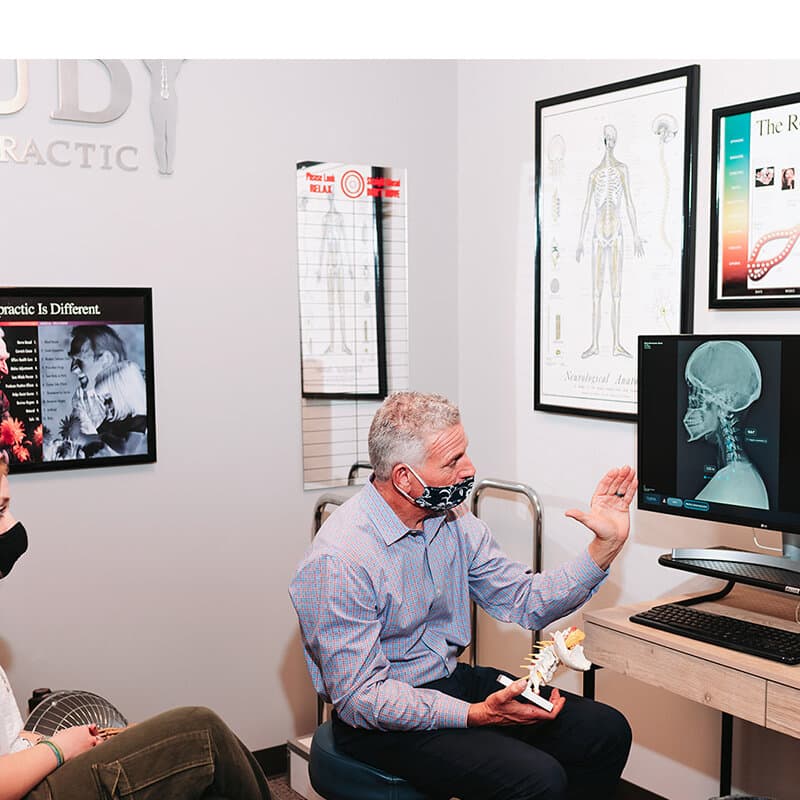
Dr. Foudy reviewing a patient's own X-rays before recommending a plan.
When the disc is the problem
Where spinal decompression fits.
When the exam and your X-rays point to a disc as the driver, spinal decompression with added oscillation on the AccuSpina table becomes the workhorse. It gently separates the bones to take pressure off the disc, and at the peak of each pull it oscillates like a gentle pump. Laboratory and imaging studies suggest that gently separating the bones lowers the pressure inside the disc so it can draw in fluid and nutrients. When the pain is muscular or joint-driven instead, the adjustment and flexion-distraction do most of the work, and we leave the table out of it. The first visit tells us which one you are.
The AccuSpina is an FDA-cleared Class II device for non-surgical spinal decompression, and its oscillation is genuinely patented technology (USPTO US 7,717,870). Those are facts about the machine, not a promise about your case. Whether it fits you is exactly what the first visit screens for.
A patient set up for a decompression cycle on the AccuSpina table.
Straight talk
One visit tells you what is going on, and I will tell you straight.
The show-and-tell consultation is the full picture in one visit: the postural scales, the surface EMG (an EKG of your nervous system), the digital X-rays, and the hands-on exam, all in about 75 minutes. You will see your own scan and your own films, and you will leave with a straight answer about your lower back pain.
If this is mine to fix, I will tell you the plan. If it is not, I will tell you that too, and point you to what actually helps. I would rather send you down the street than put you on a plan that was never going to help your case. The first visit is $90 and runs about 75 minutes.
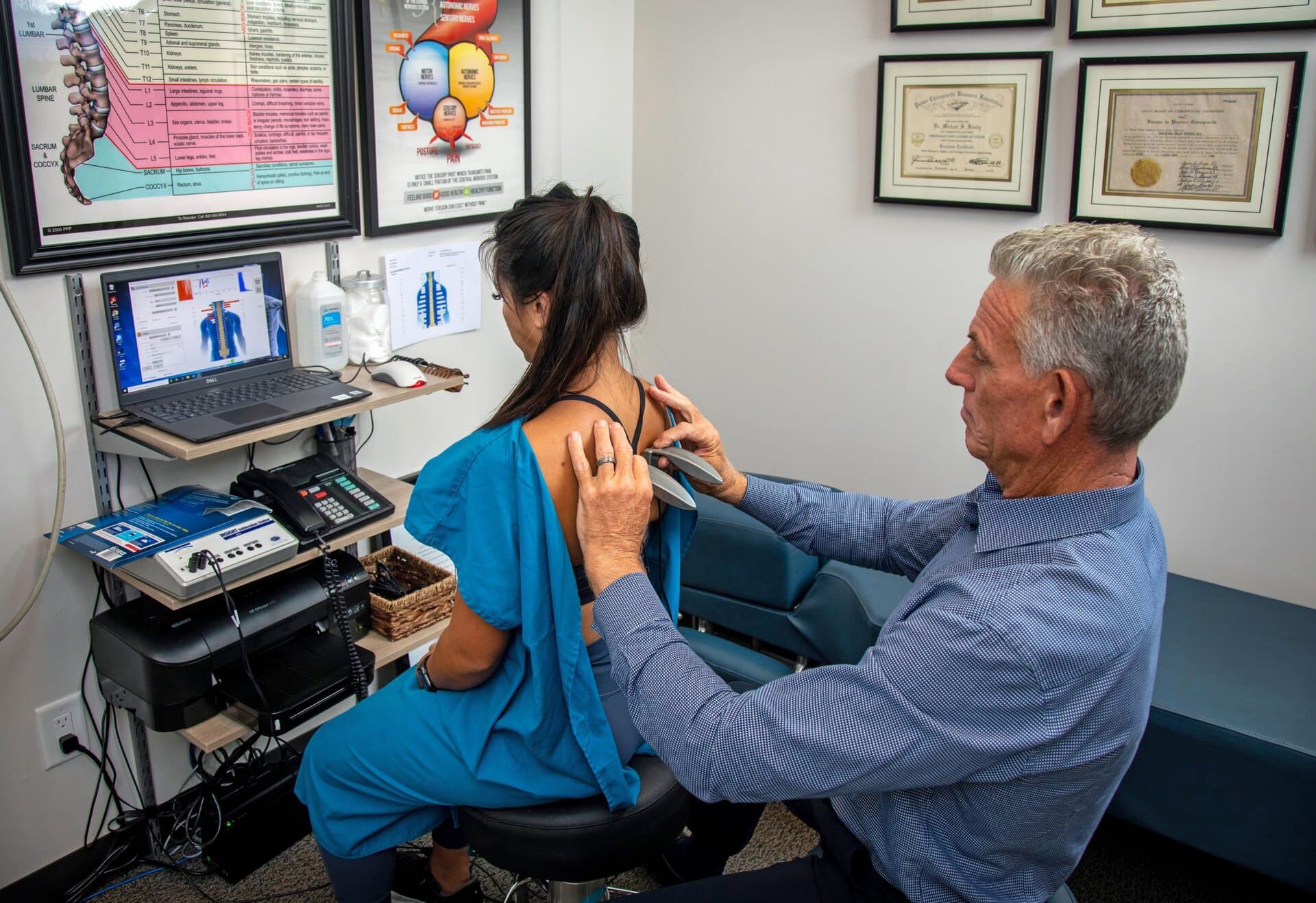
Dr. Foudy reviewing a computerized nervous-system scan with a patient, like an EKG of the nervous system.
Good questions, asked often
Questions patients ask about lower back pain
Pattern tells you a lot. Disc pain usually has something running down the leg, while muscle and facet pain stays more local. The neurological screen, the surface EMG, and your X-rays confirm the story so we treat the right thing.
Move, gently. Bed rest past a day or two stiffens the joints and weakens the very muscles you need to come out of this. Walking is the universal medicine. I will tell you which movements to favor and which to lay off for now.
No. I have taken on twenty-year-old back problems and gotten people back to a different body. Long-standing pain takes a true corrective plan, not a one-and-done, but the door is open.
Not always. Digital X-rays and the EMG usually tell us what we need in the room. We order an MRI only if your neurological findings or your response to care call for it.
Only if we stop at relief instead of correction. After the corrective phase we move to a retainer schedule, the way braces hand off to a retainer, so what we fixed stays fixed.
The show-and-tell consultation in Mission Viejo includes the exam, the surface EMG, and the X-rays, about $90 and 75 minutes. You will see your own scan and your own films, and you will leave with a straight answer. Patients come to us from Lake Forest, Aliso Viejo, Laguna Niguel, Rancho Santa Margarita, and across Mission Viejo. Call Call (949) 365-0403 and ask for Carmen.