My doctor said I have degenerative disc disease. Is that as bad as it sounds?
Take a breath. The name sounds like a sentence, but degenerative disc disease is mostly your discs getting drier and thinner with the years, and yes, I can almost always help you live well with it. Here in Mission Viejo, one show-and-tell visit shows you on your own X-rays exactly where you stand.
One unhurried visit tells you what is going on and whether Dr. Foudy can help. Thursday is afternoons only, 3:00 to 6:00 pm.
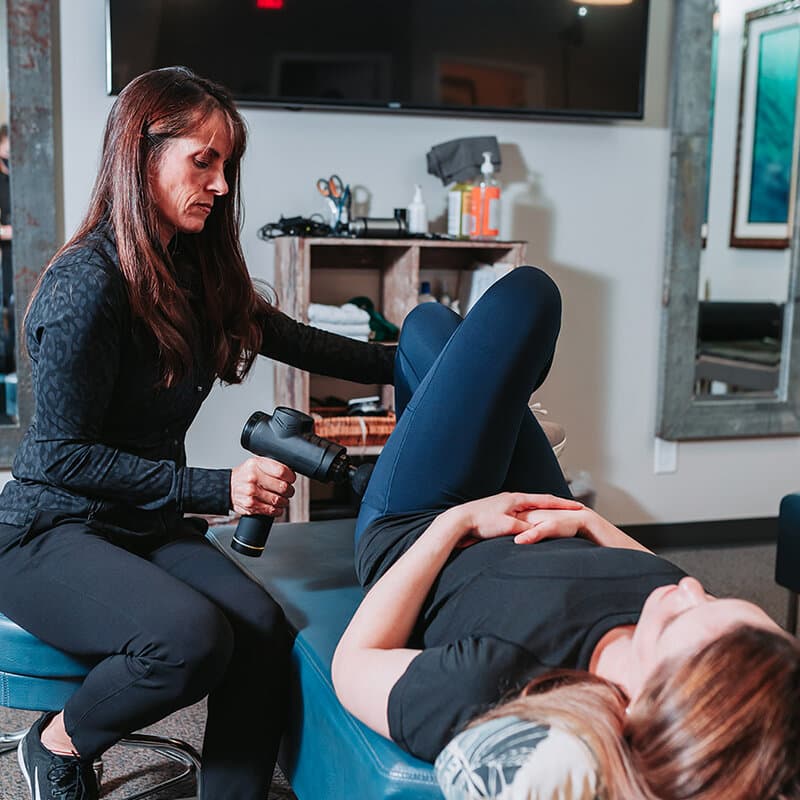
Staff setting up a patient on the AccuSpina spinal decompression table
In your own words
Does one of these sound like you?
Most patients arrive describing how they feel, not naming a diagnosis. If one of these is yours, you are in the right place. One visit tells you where you stand.
My back aches all the time, like a deep, low, dull ache that never fully turns offThe X-ray report said degeneration and decreased disc space, and now I am scaredIt is worse when I sit, and worse again when I have been on my feet too long, like there is no good positionSome days are fine and then I bend wrong and I am wiped out for a weekI feel like my back is just wearing out and there is nothing to do about it
What is actually going on
What is actually going on, in plain terms.
Degenerative disc disease is not really a disease, and that word scares people more than it should. Your discs are like jelly donuts that sit between the bones of your spine and cushion them. Over the years, especially through your 30s and 40s, the jelly dries out, the donut gets thinner, and the space between the bones shrinks. That lost height is what the report calls decreased disc space. A flatter, drier disc has less cushion, so it gets irritated more easily and the joints around it take on extra load. It is wear, not doom. The job is not to reverse the years, it is to take the load off the worn disc, keep the spine moving, and build the muscles around it so they carry their share.
Staff setting up a patient on the AccuSpina spinal decompression table
Can you help me, what is it, how long, and how much.
These are the four questions I hear on every first call, so here they are answered in order. The honest version of each, with real numbers, not a sales pitch.
Can you help me?
Yes, here is the honest answer.
Almost always, yes, in the sense that matters: I can help you live well with it. I am not going to reverse the years on a worn disc, and I will say so plainly. What I can do is take the load off, calm the flares, restore motion, and keep you out of the wiped-out-for-a-week cycle. The rare exceptions, a fracture or a tumor, go elsewhere. One visit tells us which one you are.
What is it?
What is actually going on.
It is discs that have dried out and thinned with the years, with the lost height the report calls decreased disc space. The X-rays show the structure, the surface EMG shows how the nervous system is firing around it, and together they tell us whether the degeneration is your actual pain generator or just something age put on the film.
How long?
How long it usually takes.
This is a manage-it-well condition, not a one-and-done. A flare often calms down in a few weeks. When a worn disc is the driver, the decompression course runs as a correction phase, then a progress exam, then a retainer schedule to hold it. The longer-term piece is the corrective exercise and the lifestyle work. Your exact plan is set after your exam.
How much?
What it costs, plainly.
The show-and-tell consultation that reads your case is $90 and about 75 minutes. A standard adjustment visit is $90 with the modalities included. If a worn disc needs decompression, the standard 20-visit program is $3,000 and a single session is $160. We go over your exact plan in person, after I have seen your films.
Who this helps, and who it does not
Are you a candidate for care here?
You are a good fit if the degeneration is driving your pain and you do not have one of the genuine reasons decompression is off the table. When I refer out or hold off: severe osteoporosis, a fracture, a spinal tumor or infection, prior fusion or hardware at the level, pregnancy, or progressive neurological loss. And sometimes the degeneration on your film is not the thing hurting you at all, in which case I tell you straight and we treat what actually is. The first visit is exactly what sorts that out.
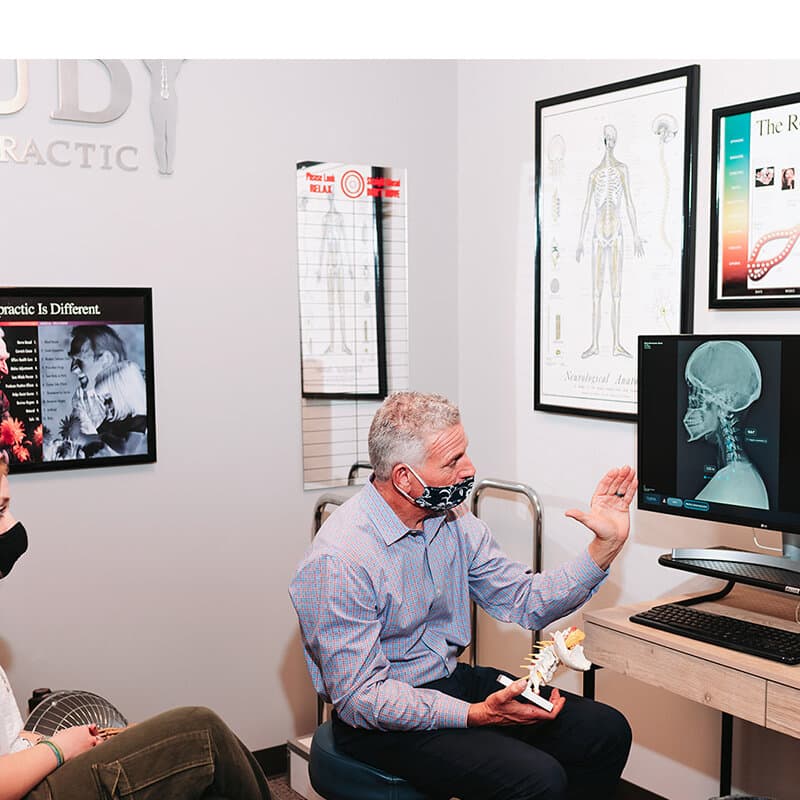
Dr. Foudy reviewing a patient's own X-rays before recommending a plan.
When the disc is the problem
Where spinal decompression fits.
When a worn disc needs room, spinal decompression with added oscillation on the AccuSpina can take the load off it. It gently separates the bones, and at the peak of each pull it oscillates, like a gentle pump. Laboratory and imaging studies suggest that easing the bones apart lowers the pressure inside the disc so it can draw in fluid and nutrients. With degenerative discs I am candid that we are managing a worn structure, not rebuilding a new one, so the table is one tool inside a plan that leans heavily on motion and corrective exercise. The first visit tells us whether it fits your case.
The AccuSpina is an FDA-cleared Class II device for non-surgical spinal decompression, and its oscillation is genuinely patented technology (USPTO US 7,717,870). Those are facts about the machine, not a promise about your case. Whether it fits you is exactly what the first visit screens for.
A patient set up for a decompression cycle on the AccuSpina table.
Straight talk
One visit tells you what is going on, and I will tell you straight.
The show-and-tell consultation is the full picture in one visit: the postural scales, the surface EMG (an EKG of your nervous system), the digital X-rays, and the hands-on exam, all in about 75 minutes. You will see your own scan and your own films, and you will leave with a straight answer about your degenerative disc disease.
If this is mine to fix, I will tell you the plan. If it is not, I will tell you that too, and point you to what actually helps. I would rather send you down the street than put you on a plan that was never going to help your case. The first visit is $90 and runs about 75 minutes.
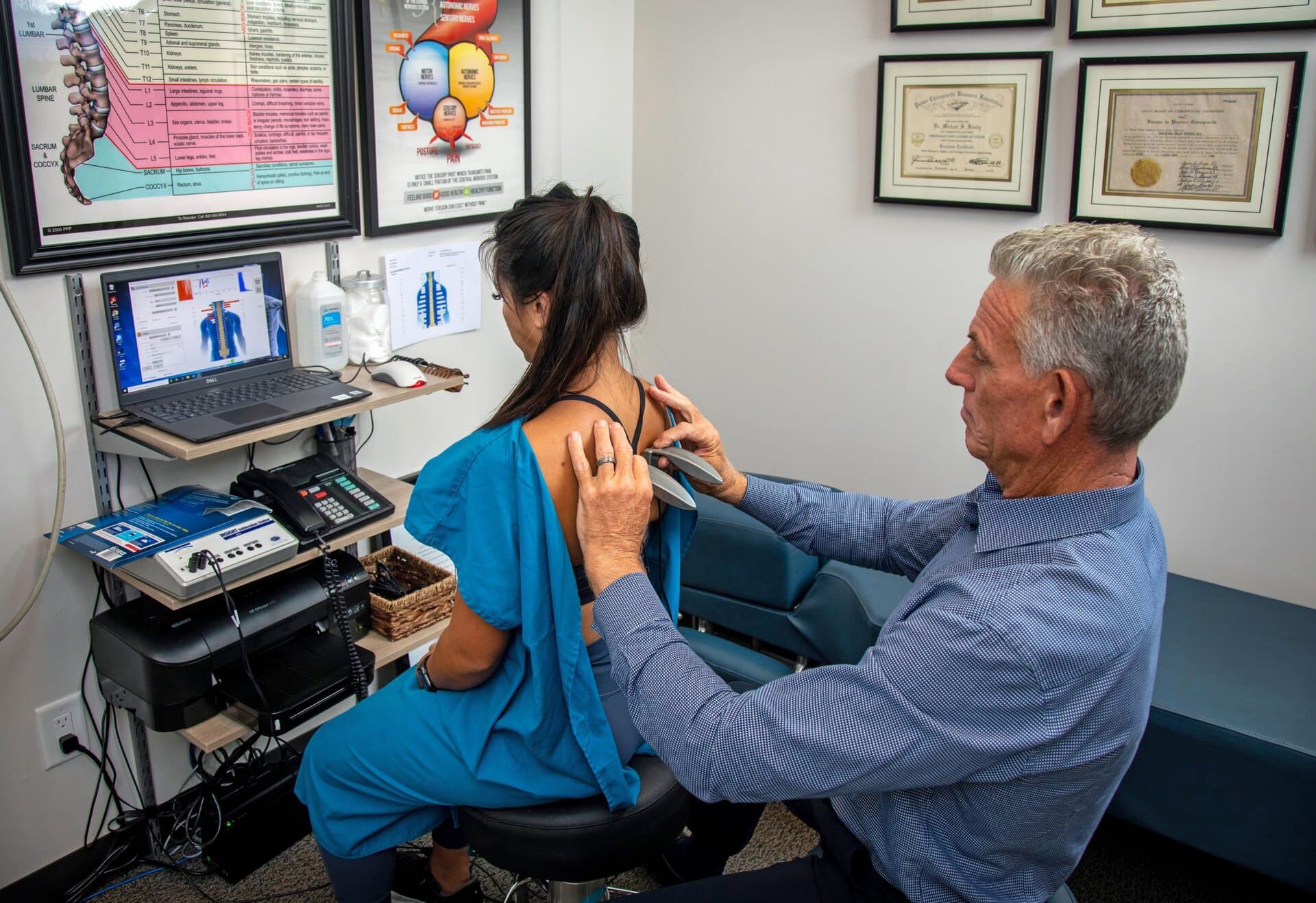
Dr. Foudy reviewing a computerized nervous-system scan with a patient, like an EKG of the nervous system.
Good questions, asked often
Questions patients ask about degenerative disc disease
The name sounds like a sentence, but it is mostly your discs getting drier and thinner with the years. It is extremely common, it shows up on plenty of X-rays, and it does not automatically mean a life of pain. The exam tells us whether the degeneration is what is actually hurting you, and most people learn to live well with it.
No, and I will not tell you otherwise. We do not turn the clock back on a worn disc. What we can do is take the load off it, restore motion to the joints around it, calm the flares, and build the supporting muscles so the disc is not carrying the whole burden. The goal is to live well with it.
For the right case, it can give a worn disc room and take pressure off the nerve. Laboratory and imaging studies suggest that easing the bones apart lowers the pressure inside the disc so it can draw in fluid and nutrients. That is how the table is designed to work, not a promise for any one patient. The first visit tells us whether it fits your case.
No. Motion is what keeps a worn spine working. Heavy axial loading and deep bending under load come off the program for a while, but walking, swimming, and Melanie’s corrective routine are part of the plan. A spine you keep moving holds up better than one you protect into stiffness.
They travel together. Degenerative disc disease is the disc drying and thinning. Facet arthrosis (arthritis of the small joints) often comes along with it as those joints take on extra load. The X-rays show both, and the plan addresses the load that is driving them.
The show-and-tell consultation in Mission Viejo includes the exam, the surface EMG, and the X-rays, about $90 and 75 minutes. You will see your own scan and your own films, and you will leave with a straight answer. Patients come to us from Lake Forest, Aliso Viejo, Laguna Niguel, Rancho Santa Margarita, and across Mission Viejo. Call Call (949) 365-0403 and ask for Carmen.