Why do my legs ache when I walk and feel better when I sit?
That walk-and-ache, sit-and-relief pattern is the classic sign of spinal stenosis, a narrowing of the space your nerves travel through, and yes, we can often help you keep walking. At Foudy Chiropractic in Mission Viejo, one show-and-tell visit with digital X-rays and a surface EMG tells us how much the narrowing is the driver and whether care here fits your case or belongs with a surgeon.
One unhurried visit tells you what is going on and whether Dr. Foudy can help. Thursday is afternoons only, 3:00 to 6:00 pm.
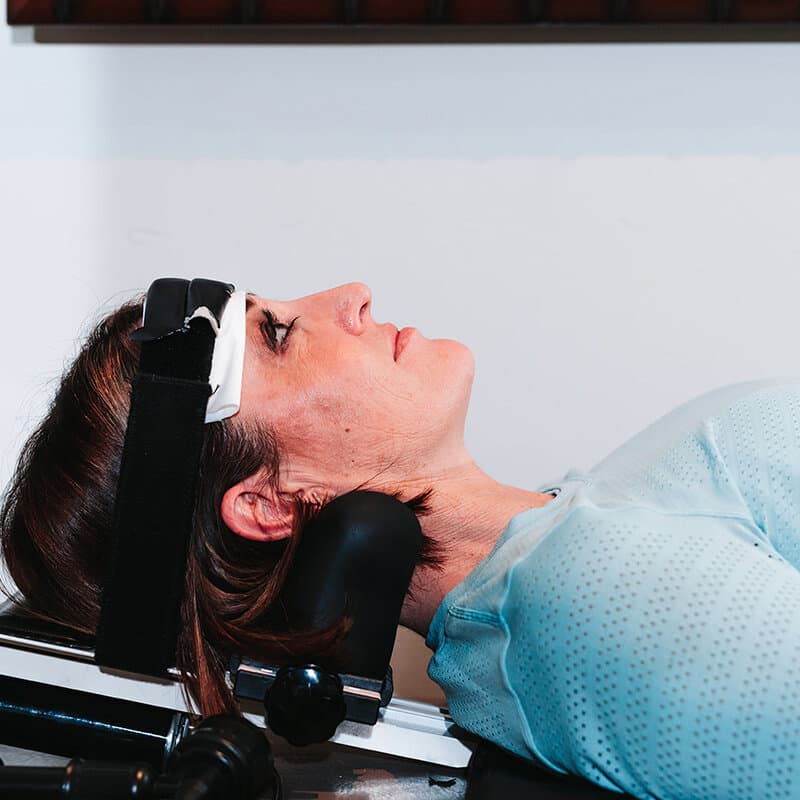
Patient receiving cervical traction therapy at Foudy Chiropractic
In your own words
Does one of these sound like you?
Most patients arrive describing how they feel, not naming a diagnosis. If one of these is yours, you are in the right place. One visit tells you where you stand.
My legs start aching and going heavy when I walk a waysThey ease up the second I sit or lean forward on the cartI can walk farther bent over the cart than I can standing up straightBoth legs feel it, with numbness or tingling, not just one sideStanding in one spot, like at the sink, gets old fast
What is actually going on
What is actually going on, in plain terms.
Spinal stenosis is a narrowing of the channels the nerves pass through in your spine. Picture a busy hallway that has slowly gotten narrower as thickened ligaments, bone spurs, and bulging discs crowd in from the sides. The nerves still have to get through, and when you stand or walk upright the hallway is at its tightest, so the legs ache and go heavy. The moment you sit or lean forward over a cart, the hallway opens up a little and the crowding eases. That is why the relief is so predictable. It is mostly the wear of the years, and it often travels with degenerative disc disease and decreased disc space. The job is to create room, keep the nerves moving, and keep you walking.
Patient receiving cervical traction therapy at Foudy Chiropractic
Can you help me, what is it, how long, and how much.
These are the four questions I hear on every first call, so here they are answered in order. The honest version of each, with real numbers, not a sales pitch.
Can you help me?
Yes, here is the honest answer.
Often, yes, in the sense of keeping you mobile and out of the constant ache. The goal with stenosis is room and motion, and a lot of patients do well with conservative care. I am also honest that some stenosis is advanced enough to need a surgeon, and I will say so plainly if that is where your case sits. One visit tells us which one you are.
What is it?
What is actually going on.
It is a narrowing of the space your nerves travel through, usually from the wear of the years, thickened ligaments, bone spurs, and bulging discs crowding the canal. The X-rays show the structure and the surface EMG shows how the nerves are firing. The walk-and-rest, lean-forward-for-relief pattern is one of the clearest tells, and I look for it on the exam.
How long?
How long it usually takes.
Stenosis is a manage-it condition more than a fix-it-once condition. Many patients get meaningful relief from a course of care over several weeks plus the corrective exercise that keeps them moving. The exact plan, and whether decompression has any role, comes after the exam and the X-rays.
How much?
What it costs, plainly.
The show-and-tell consultation that reads your case is $90 and about 75 minutes. A standard adjustment visit is $90 with the modalities included. If the exam supports decompression, the standard 20-visit program is $3,000 and a single session is $160. We go over your exact plan in person, after I have seen your films.
Who this helps, and who it does not
Are you a candidate for care here?
You are a good fit for care here when the stenosis is mild to moderate and the goal is keeping you mobile, which describes a lot of patients. When I refer out instead: progressive leg weakness, a walking distance that keeps shrinking despite care, numbness in the saddle area, or any loss of bladder or bowel control, those go for a surgical opinion, not a treatment plan. Severe, high-grade narrowing often belongs with a spine surgeon too. The first visit is exactly what tells us which case you are, and I would rather send you to the right specialist than keep you on a plan that was never going to be enough.
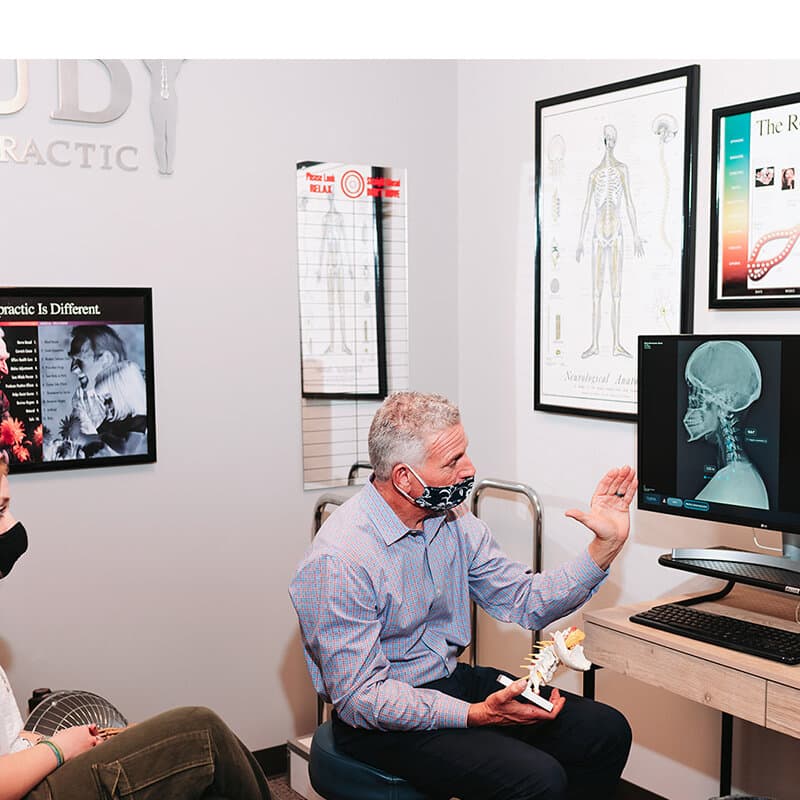
Dr. Foudy reviewing a patient's own X-rays before recommending a plan.
Straight talk
One visit tells you what is going on, and I will tell you straight.
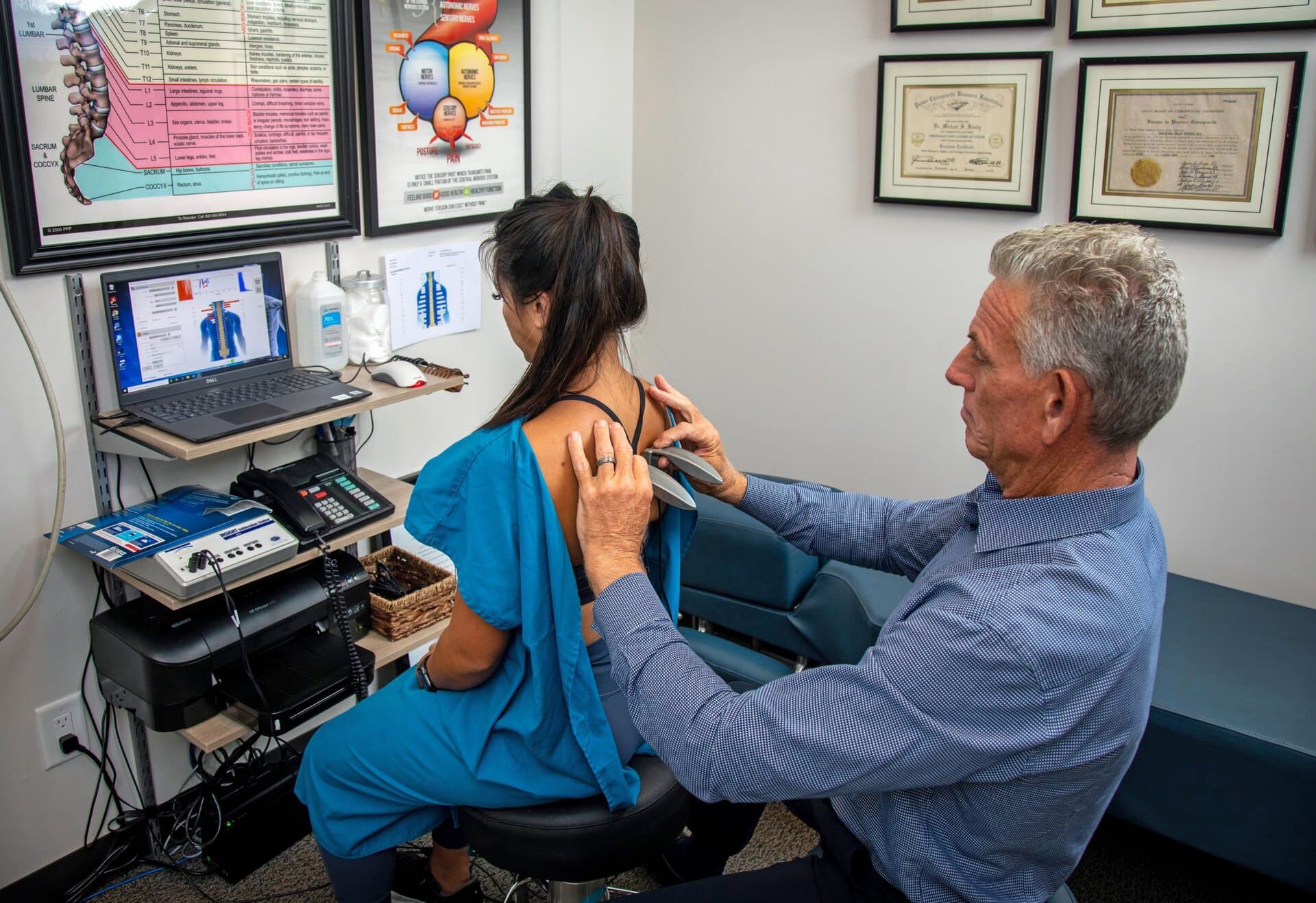
The show-and-tell consultation is the full picture in one visit: the postural scales, the surface EMG (an EKG of your nervous system), the digital X-rays, and the hands-on exam, all in about 75 minutes. You will see your own scan and your own films, and you will leave with a straight answer about your spinal stenosis.
If this is mine to fix, I will tell you the plan. If it is not, I will tell you that too, and point you to what actually helps. I would rather send you down the street than put you on a plan that was never going to help your case. The first visit is $90 and runs about 75 minutes.
Dr. Foudy reviewing a computerized nervous-system scan with a patient, like an EKG of the nervous system.
Good questions, asked often
Questions patients ask about spinal stenosis
It is a narrowing of the space the nerves travel through in your spine. As that space tightens, the nerves get crowded. The telltale sign is legs that ache or go heavy when you walk or stand and feel better the moment you sit or lean forward, because leaning forward opens the canal a little.
Because bending forward opens up the narrowed canal and gives the crowded nerves a little more room. That cart-lean relief is one of the most recognizable signs of stenosis, and it is one of the things I look for on the exam.
For many people, yes, the goal is to create room, keep the joints and nerves mobile, and keep you walking. Flexion-distraction and the adjustment work with the way the canal opens in flexion. I am also honest that some stenosis is advanced enough to need a surgical opinion, and the first visit is what tells us which case you are.
Not always. Plenty of stenosis is managed well without surgery. Surgery moves up the list when there is progressive weakness, when walking distance keeps shrinking despite care, or when the exam shows red flags. I will tell you straight where your case sits.
No, though they can overlap. A herniated disc is one disc pressing on a nerve, often down one leg. Stenosis is a broader narrowing of the canal, often crowding nerves on both sides, with that classic walk-and-rest, lean-forward-for-relief pattern. The exam sorts out which one, or whether you have both.
The show-and-tell consultation in Mission Viejo includes the exam, the surface EMG, and the X-rays, about $90 and 75 minutes. You will see your own scan and your own films, and you will leave with a straight answer. Patients come to us from Lake Forest, Aliso Viejo, Laguna Niguel, Rancho Santa Margarita, and across Mission Viejo. Call Call (949) 365-0403 and ask for Carmen.