Yes, we can often help, and the place to start is your neck. Many recurring headaches start at the upper cervical spine and travel up into the head. At Foudy Chiropractic in Mission Viejo, one show-and-tell visit includes an AP open-mouth X-ray that looks straight at the atlas and axis, a view most headache patients have never had taken, so we can see whether your neck is part of the picture.
One unhurried visit tells you what is going on and whether Dr. Foudy can help. Thursday is afternoons only, 3:00 to 6:00 pm.
Dr. Foudy performing a gentle cervical adjustment on a younger patient
In your own words
Does one of these sound like you?
Most patients arrive describing how they feel, not naming a diagnosis. If one of these is yours, you are in the right place. One visit tells you where you stand.
I'm getting these headaches that are kind of all over my headThey are worse in the second half of the dayI get a tight band across my foreheadThey flare with screen time, driving, or stressI feel pain at the base of my skull that creeps up
What is actually going on
What is actually going on, in plain terms.
A lot of headaches are not really a head problem, they are a neck problem that you feel in your head. When the upper neck, the atlas and axis right at the base of the skull, sits out of alignment, it refers pain up and over the head, and the muscles at the back of the neck stay tight trying to guard it. Forward head posture from screens keeps reloading that upper neck, which is why the headaches build through the day. Tension headaches come from that same sustained muscle contraction. Migraines are their own neurological event, but plenty of them have a cervical trigger sitting underneath. The AP open-mouth X-ray lets me look right at the C1 and C2 relationship, and most headache patients have never had that view taken.
Dr. Foudy performing a gentle cervical adjustment on a younger patient
Can you help me, what is it, how long, and how much.
These are the four questions I hear on every first call, so here they are answered in order. The honest version of each, with real numbers, not a sales pitch.
Can you help me?
Yes, here is the honest answer.
Often, yes, especially the headaches that have a neck component, which is more of them than people expect. I am honest that some headaches are not a spine problem at all, and new, severe, or rapidly changing headaches get sent for the right medical workup first. The exam tells us which kind you have.
What is it?
What is actually going on.
Usually a cervicogenic or tension pattern, headache referred from the upper neck and the muscle guarding around it, sometimes with a migraine on top. The neurological screen and the AP open-mouth X-ray of the atlas and axis tell us whether the neck is driving it. I show you what I find.
How long?
How long it usually takes.
Tension and cervicogenic headaches often drop in frequency inside a few weeks of care. Long-standing patterns take a few months to retrain, because the posture and the upper-neck mechanics have to change and stay changed. Your exact plan is set after your exam.
How much?
What it costs, plainly.
The show-and-tell consultation, including the AP open-mouth X-ray, is $90 and about 75 minutes. A standard adjustment visit is $90 with the Theragun and electric stim for the trap and occipital muscles when you need them. We go over your plan in person.
Who this helps, and who it does not
Are you a candidate for care here?
You are a good fit if your headaches have a neck or posture component, which covers a large share of recurring headaches. When I refer out: a sudden severe headache, the worst headache of your life, a headache with fever, vision loss, slurred speech, or weakness, or any new or rapidly changing pattern, those need urgent medical evaluation, not a chiropractor first. If what I find is not mine to fix, I will tell you straight and send you to the right person.
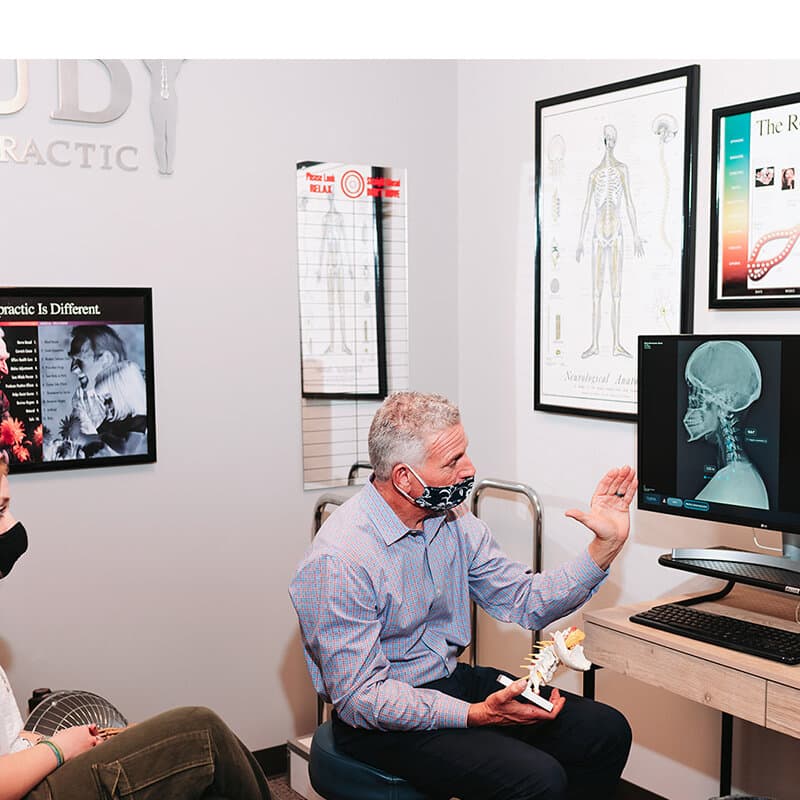
Dr. Foudy reviewing a patient's own X-rays before recommending a plan.
Straight talk
One visit tells you what is going on, and I will tell you straight.
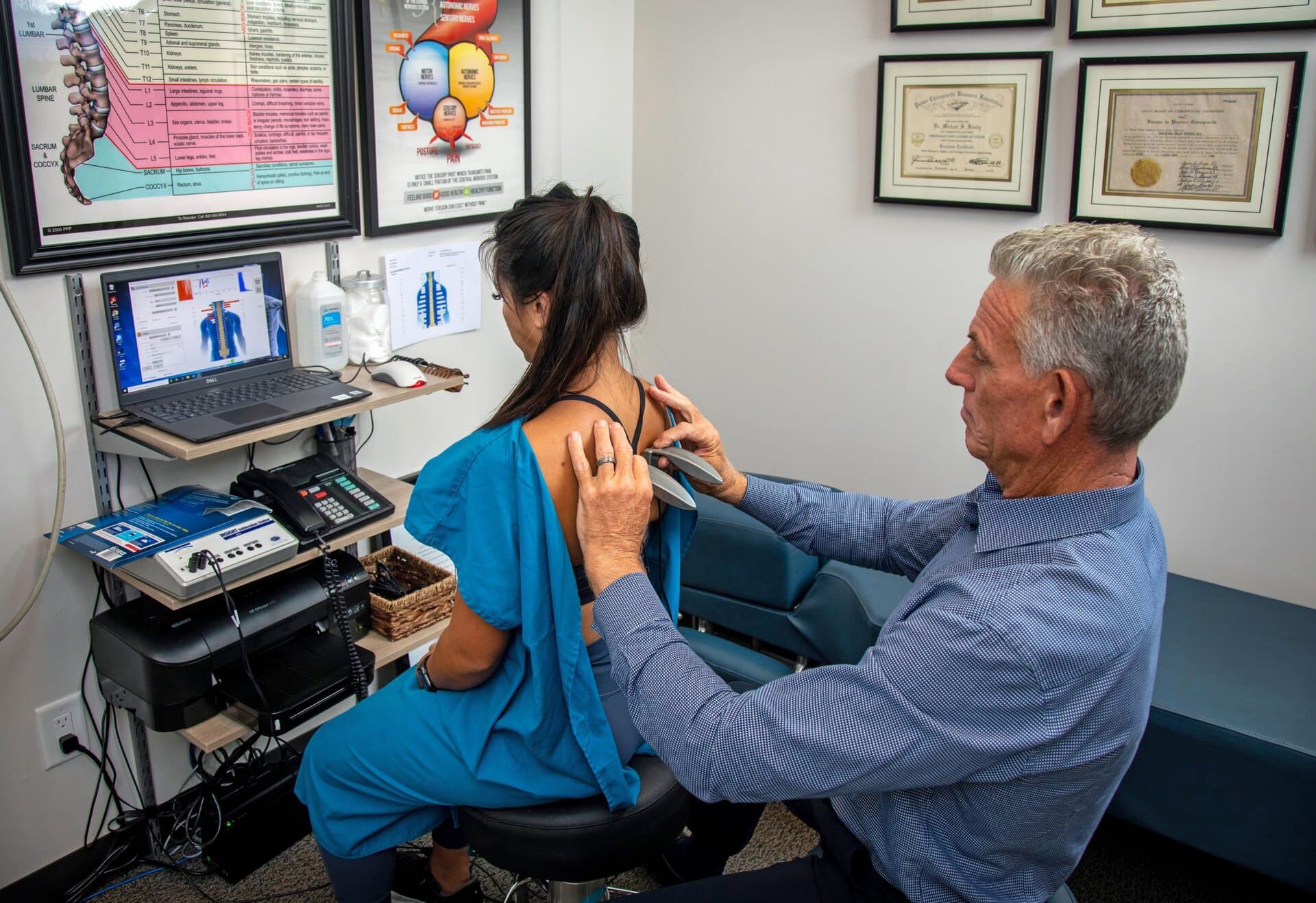
The show-and-tell consultation is the full picture in one visit: the postural scales, the surface EMG (an EKG of your nervous system), the digital X-rays, and the hands-on exam, all in about 75 minutes. You will see your own scan and your own films, and you will leave with a straight answer about your headaches.
If this is mine to fix, I will tell you the plan. If it is not, I will tell you that too, and point you to what actually helps. I would rather send you down the street than put you on a plan that was never going to help your case. The first visit is $90 and runs about 75 minutes.
Dr. Foudy reviewing a computerized nervous-system scan with a patient, like an EKG of the nervous system.
Good questions, asked often
Questions patients ask about headaches
Some migraines have a cervical trigger, and adjusting the upper cervical spine can lower the frequency for those patients. Dr. Foudy is clear about which type of headache is responsive and which is not.
No. We work alongside whatever your physician has you on. As the headaches respond, you and your physician can decide together what to taper.
It's a quick X-ray of the open mouth that shows the relationship between C1 and C2. Most people are surprised it has not been ordered before. It takes about 30 seconds.
Yes. Upper cervical dysfunction can affect autonomic nervous system regulation. We see brain fog and headaches improve together more often than not.
The show-and-tell consultation in Mission Viejo includes the exam, the surface EMG, and the X-rays, about $90 and 75 minutes. You will see your own scan and your own films, and you will leave with a straight answer. Patients come to us from Lake Forest, Aliso Viejo, Laguna Niguel, Rancho Santa Margarita, and across Mission Viejo. Call Call (949) 365-0403 and ask for Carmen.